

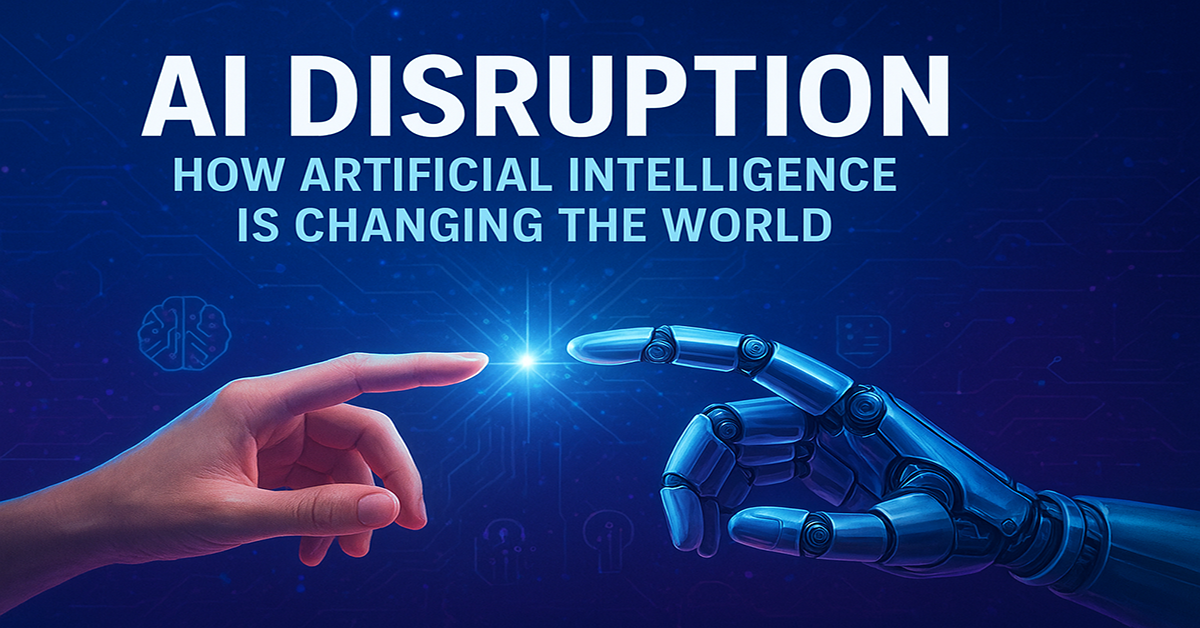
Artificial Intelligence (AI) has moved far beyond science fiction. Today, it writes articles, diagnoses medical scans, answers customer questions, drives cars, and even creates art. This rapid progress is what many call AI disruption—a massive shift in how people work, how businesses compete, and how societies function.
What does “AI disruption” mean?
“Disruption” happens when a new technology changes the way things have always been done. Just as electricity replaced candles or smartphones replaced landlines, AI is transforming jobs, industries, and even everyday life.
Unlike older technologies that mainly replaced physical labor, AI is now handling mental and creative tasks: writing reports, designing images, analyzing data, and translating languages. That makes its impact broader and faster than most past innovations.
Where is AI disruption happening?
1. Everyday customer service
Chatbots powered by AI can answer questions 24/7, help people order products, or solve simple problems instantly. This saves companies money and gives customers faster service.
2. Healthcare
AI tools can spot diseases in X-rays or blood tests faster than doctors in some cases. They also help researchers design new medicines. Still, doctors remain crucial for human judgment and care.
3. Finance and law
Banks use AI to detect fraud or to help with paperwork. Lawyers use it to review contracts quickly, reducing hours of repetitive reading.
4. Creative industries
AI can draw pictures, make music, or draft marketing campaigns. Instead of replacing creativity, it often acts as a co-pilot—speeding up the work while humans provide the vision and final touch.
5. Factories and logistics
Robots powered by AI are becoming smarter, improving how goods are made and shipped around the world. AI also helps manage supply chains, predicting what products will be needed and when.
The big picture: Economy and jobs
AI disruption brings both opportunity and challenge.
- More productivity. Tasks that once took hours—like writing a report or analyzing numbers—can now take minutes. This means higher output for businesses and potentially lower costs for consumers.
- Job changes. Some jobs will shrink or disappear, especially those with repetitive tasks like data entry or basic customer support. At the same time, new roles are emerging: AI trainers, data specialists, and people who supervise AI systems.
- Inequality concerns. High-skilled workers who know how to use AI may benefit the most, while others could be left behind if retraining opportunities are limited.
History shows that while technology disrupts jobs, it also creates new ones. The key question is whether society will help workers make the transition in time.
Risks and challenges
AI disruption isn’t only about benefits—it also raises serious concerns:
- Bias. If AI is trained on biased data, it can make unfair decisions in hiring, lending, or even law enforcement.
- Misinformation. Deepfakes and fake news created by AI can spread quickly online, making it harder to know what’s real.
- Privacy. AI systems often need large amounts of data, raising questions about how personal information is used.
- Concentration of power. A few big tech companies control much of today’s AI, sparking debates about monopolies and fairness.
How society can respond
To ensure AI disruption benefits more people, several steps are crucial:
- Education and training. Workers need opportunities to learn new skills so they can adapt to AI-powered jobs.
- Ethical rules. Governments and businesses must set clear standards for safe, fair, and responsible use of AI.
- Fair access. Small businesses and developing regions should have access to AI tools—not just the richest companies and countries.
- Human + AI teamwork. Instead of replacing people, AI should be used to augment human strengths: creativity, empathy, and decision-making.
Conclusion: A tool, not a destiny
AI disruption is not the end of work or society as we know it—it is a powerful tool that can reshape both for better or worse. The direction depends on choices made now by companies, governments, and individuals.
If managed well, AI can raise living standards, improve healthcare, and free humans from repetitive tasks. If handled poorly, it could widen inequalities and erode trust. The disruption is here, but the outcome is still in human hands.