The Skills Economy in the AI Age (5-Minute Read)

The Skills Economy
Share on social media:
The Skills Economy

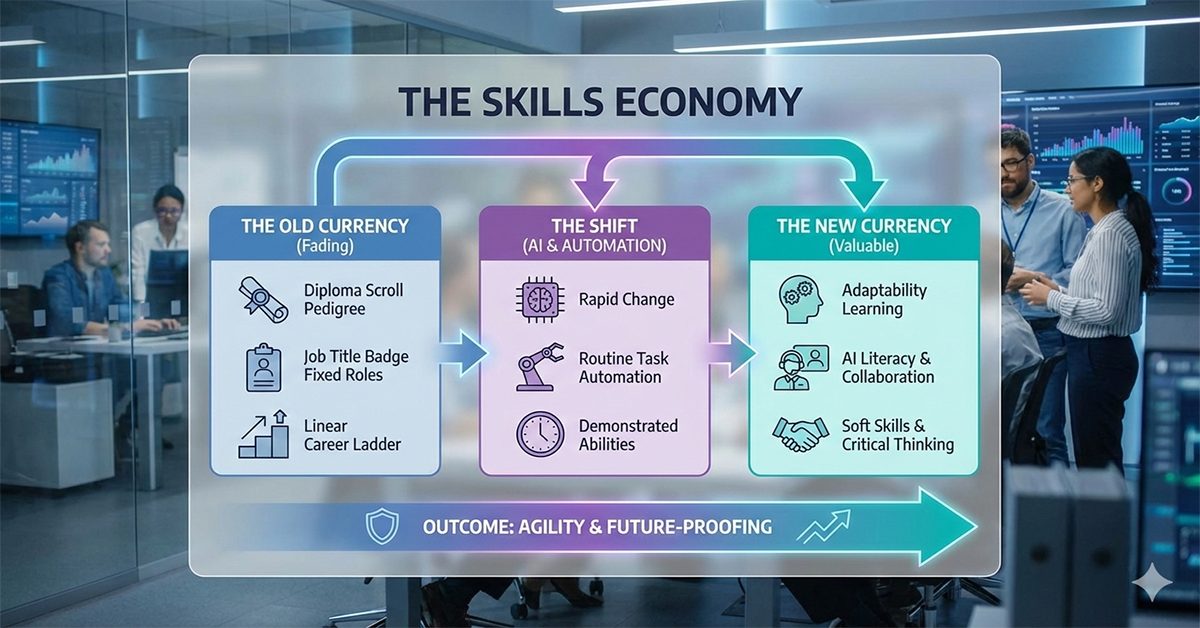
Degrees are losing power. Job titles are fading. In the age of artificial intelligence, skills have become the worldโ€™s most valuable currency.

Welcome to the skills economyโ€”where what you can do matters more than what you claim to be.


The Big Shift

AI is not just changing jobsโ€”itโ€™s changing how value is measured.

Routine tasks are automated. Predictable roles are shrinking. Meanwhile, people who can think, adapt, and work with AI are moving aheadโ€”fast.

The question employers now ask is simple:

Can you deliver results?


What Is the Skills Economy?

The skills economy rewards demonstrated ability over credentials.

In this system:

  • Portfolios beat resumes
  • Skills beat degrees
  • Proof beats promises

Learning is no longer something done once in lifeโ€”itโ€™s continuous, lifelong, and unavoidable.


Why AI Accelerated Everything

Artificial intelligence works best at:

  • Repetition
  • Speed
  • Scale

Humans work best at:

  • Creativity
  • Judgment
  • Emotional intelligence
  • Strategic thinking

AI didnโ€™t replace humansโ€”it exposed what actually makes humans valuable.


Skills That Matter Most Right Now

The most future-proof professionals combine technical awareness with human strengths.

Top skill categories:

  • AI & data literacy
  • Critical thinking
  • Communication
  • Creativity
  • Adaptability

These skills travel across industries, borders, and economic cycles.


How Hiring Is Changing

Hiring is moving away from credentials and toward capability.

Modern employers increasingly use:

  • Skills-based tests
  • Real-world tasks
  • Project portfolios
  • Global talent pools

The resume is no longer king. Results are.


Who Winsโ€”and Who Doesnโ€™t

Winners in the skills economy:

  • Lifelong learners
  • People who stack multiple skills
  • Those who use AI as leverage

Those left behind:

  • Workers relying on outdated credentials
  • Roles built purely on repetition
  • Resistance to reskilling

The real divide is not educationโ€”itโ€™s adaptability.


Why This Is a Global Game-Changer

The skills economy breaks geographic barriers.

A skilled individual with internet access can now compete globallyโ€”often outperforming candidates with elite backgrounds but obsolete skills.

This is reshaping:

  • Careers
  • Income distribution
  • Economic power

The Future of Work

The future belongs to people who treat skills like assets and learning like a habit.

In the AI age:

  • Skills expire faster
  • Reinvention is constant
  • Humanโ€“AI collaboration defines success

Final Takeaway

AI didnโ€™t make humans irrelevant.

It made skills unavoidable.

Those who adapt will thrive.
Those who donโ€™t will struggle.

The skills economy isnโ€™t coming.

Itโ€™s already here.

Share on social media:

The Ultimate Productivity Toolkit for 2026: Apps, Habits, and Strategies

2026 Productivity Portfolio
Share on social media:
2026 Productivity Portfolio

As we step into 2026, productivity is no longer just about working harderโ€”itโ€™s about working smarter. Iโ€™ve spent years experimenting with tools, habits, and strategies, and Iโ€™ve discovered ways to optimize focus, energy, and output. Hereโ€™s my ultimate toolkit for staying ahead this year.


1. Top Productivity Apps for 2026

The digital world is evolving fast. Here are the must-have apps that will help you manage tasks, stay focused, and collaborate efficiently:

  • AI Task Managers: Automate repetitive work and plan your day efficiently.
  • Project Management Tools: Platforms like Notion, Asana, or ClickUp remain essential for teams and solo projects.
  • Focus Apps: Pomodoro timers, noise generators, and AI-driven focus assistants help minimize distractions.
  • Time Tracking Tools: Track where your time goes and optimize your workflow.

2. Work Habits That Make a Difference

Apps alone arenโ€™t enough. Your habits define your productivity:

  • Time Blocking: Dedicate specific hours to focused work and deep thinking.
  • Digital Minimalism: Limit social media and notifications that break your flow.
  • Batch Processing: Group similar tasks to save mental energy.
  • Review & Reflect: End each week by analyzing wins, losses, and opportunities.

3. Energy & Wellness Strategies

Your energy determines your output. To perform at your best in 2026:

  • Mindful Breaks: Short meditation, stretching, or a walk can recharge your focus.
  • Sleep Optimization: Consistent sleep cycles improve memory, creativity, and decision-making.
  • Nutrition & Hydration: Balanced meals and proper hydration sustain energy and clarity.
  • Micro-Workouts: Quick exercises to boost circulation and brain function during work hours.

4. Future-Proof Your Productivity

2026 will bring new tools, AI innovations, and evolving work patterns. The key is flexibility: combine apps, habits, and wellness practices that fit your style, then adapt as technology and workflows change. Productivity is no longer one-size-fits-allโ€”itโ€™s about crafting your personalized system to thrive in a fast-changing world.


Conclusion:
With the right combination of apps, habits, and energy strategies, 2026 can be your most productive year yet. Start small, experiment often, and refine your toolkit until it works perfectly for you.

Share on social media:

Digital Hoarding: The Hidden Epidemic of the Digital Age

Bunch of digital devices
Share on social media:
Bunch of digital devices

In todayโ€™s connected world, digital clutter is becoming an invisible but significant problem. Known as digital hoarding, this phenomenon affects millions globally, silently impacting productivity, mental health, and even device performance.

What is Digital Hoarding?

Digital hoarding is the tendency to accumulate and refuse to delete unnecessary digital files, emails, apps, photos, and other data, often resulting in disorganized devices and storage overload. While physical clutter is visible, digital clutter silently consumes time, attention, and resources.

Key consequences include:

  • Mental overload: A cluttered digital environment can trigger stress and reduce focus.
  • Slow devices: Excess files, apps, and data slow down phones, laptops, and cloud storage.
  • Lost productivity: Searching for files, emails, or apps becomes time-consuming.
  • Security risks: Hoarded data is often poorly organized, leaving sensitive information vulnerable.

Why Digital Hoarding Happens

Several psychological and practical factors drive digital hoarding:

  1. Fear of losing memories: Photos, videos, and messages feel irreplaceable.
  2. Potential future use: Many files are saved โ€œjust in case.โ€
  3. Emotional attachment: Digital files often carry sentimental value.
  4. Instant gratification: Downloading content or apps provides a dopamine boost.

The Global Impact

Digital hoarding is more than an individual issueโ€”itโ€™s a worldwide trend. Excess digital clutter affects mental well-being, workflow efficiency, and even financial resources. For example, paying for additional cloud storage or external drives adds hidden costs, while a cluttered device can reduce performance and increase frustration.

Signs of Digital Hoarding

  • Thousands of unread emails or unorganized inboxes.
  • Massive photo libraries left unchecked for years.
  • Downloaded apps, files, or videos rarely accessed.
  • Reluctance to delete files due to fear of losing something important.

Solutions to Reduce Digital Clutter

  1. Declutter consistently: Dedicate short, regular intervals to remove unnecessary files.
  2. Organize files: Use folders, tags, and cloud solutions strategically.
  3. Limit downloads: Only save files or apps that are essential.
  4. Use cloud storage wisely: Store important items online, but avoid overloading it.
  5. Digital detox: Occasionally disconnect from devices to refresh the mind.

Why This Matters

Digital hoarding is a modern epidemic that affects billions of devices worldwide. Beyond slowing technology, it impacts mental clarity, productivity, and even personal well-being. Awareness and proactive digital organization are key to preventing long-term negative effects.

Every device cleared of clutter is a step toward mental clarity and efficiency, and spreading awareness about digital hoarding can help millions take control of their digital lives.

Share on social media:

Core Skills You Need to Thrive in 2026

Key Skills For 2026
Share on social media:
Key Skills For 2026

As we step into 2026, the world of work continues to evolve at a lightning pace. Technology, globalization, and changing workforce expectations are reshaping the skills that matter most. Staying relevant isnโ€™t just about mastering technical toolsโ€”itโ€™s about developing a combination of soft, cognitive, and digital skills that can adapt to new challenges.

Hereโ€™s my breakdown of the core skills that will define career success in 2026:


1. Digital Literacy & AI Integration

By 2026, AI and automation will touch nearly every industry. Professionals need to go beyond basic tech skills:

  • Understanding AI tools and workflows.
  • Leveraging automation to increase productivity.
  • Evaluating digital data to make informed decisions.

Being digitally literate isnโ€™t optionalโ€”itโ€™s foundational.


2. Critical Thinking & Problem Solving

Employers increasingly value the ability to:

  • Analyze complex problems.
  • Identify patterns and trends.
  • Devise innovative solutions.

Even as AI handles repetitive tasks, human judgment and creativity remain irreplaceable.


3. Emotional Intelligence & Interpersonal Skills

Machines canโ€™t replicate human empathy. By 2026, emotional intelligence (EQ) will be a core differentiator:

  • Active listening and conflict resolution.
  • Leadership that inspires collaboration.
  • Building trust across hybrid or remote teams.

High EQ drives team cohesion and organizational success.


4. Adaptability & Lifelong Learning

Change is the only constant. The ability to adapt and learn continuously will define career longevity:

  • Upskilling through microlearning or online courses.
  • Being open to role changes or cross-functional projects.
  • Resilience in the face of uncertainty.

Those who embrace change will stay ahead of the curve.


5. Creativity & Innovation

Automation handles efficiencyโ€”but creativity is still human territory. Skills in this area include:

  • Designing new processes or products.
  • Thinking outside the box to solve emerging challenges.
  • Integrating diverse perspectives to drive innovation.

Companies in 2026 will reward employees who can combine creativity with execution.


6. Data-Driven Decision Making

Data literacy is more than numbersโ€”itโ€™s insight:

  • Interpreting analytics to guide strategy.
  • Communicating findings effectively to stakeholders.
  • Balancing quantitative insights with qualitative understanding.

Those fluent in data will influence key business decisions.


7. Cross-Cultural Competence

Globalization means working with diverse teams and clients:

  • Understanding cultural nuances.
  • Communicating effectively across geographies.
  • Building inclusive and respectful workplaces.

This skill enhances collaboration and expands opportunities worldwide.


Preparing for the Future

The workplace of 2026 is fast, fluid, and tech-driven. To thrive, focus on developing a blend of technical, cognitive, and emotional skills. Continuous learning, adaptability, and human-centered abilities will separate the average professional from the exceptional one.

Share on social media:

How to Communicate With AI Effectively: A Complete Guide

Man interacting with AI
Share on social media:
Man interacting with AI

As artificial intelligence becomes more integrated into daily life, knowing how to communicate with AI effectively has become a practical digital skill. Whether interacting with chatbots, virtual assistants, or advanced generative models, clear communication leads to more accurate, helpful, and relevant results.

This guide explains the principles behind effective AI communication, along with examples anyone can apply.


1. Start With Clear and Specific Instructions

AI performs best when the request is direct. Vague prompts often lead to generic answers, while specific instructions produce focused results.

Example:

  • Vague: โ€œTell me about exercise.โ€
  • Clear: โ€œExplain the benefits of strength training for beginners in simple language.โ€

Tip: Include the purpose, scope, tone, or audience when needed.


2. Provide Context for Better Accuracy

AI relies heavily on context. Adding background information helps the system understand the intent.

Helpful context may include:

  • Target audience (students, professionals, kids)
  • Format (list, blog, step-by-step guide)
  • Desired length
  • Relevant details or constraints

Example:
โ€œWrite a 150-word summary of climate change causes for high school students.โ€


3. Break Complex Tasks Into Steps

Large or multi-layered tasks are easier for AI to complete when divided into smaller parts.

Instead of:
โ€œWrite a business plan for a cafรฉ.โ€

Try:

  1. โ€œWrite a market analysis for a small cafรฉ in an urban area.โ€
  2. โ€œCreate a simple financial projection for the first year.โ€
  3. โ€œCombine everything into a business plan.โ€

4. Ask Follow-Up Questions or Request Revisions

AI is designed for iterative conversation. If the first answer isn’t perfect, refining the prompt usually improves the output.

Useful follow-ups include:

  • โ€œMake it more concise.โ€
  • โ€œGive more examples.โ€
  • โ€œRewrite it in a friendly tone.โ€
  • โ€œExpand section 2 only.โ€

This approach works like collaborative editing.


5. Use Examples to Guide the Output

Showing AI a sample style or structure helps it mimic the desired result. Examples reduce ambiguity and increase precision.

Example:
โ€œWrite a product description similar to this style: [insert example], but for a smartwatch instead of shoes.โ€


6. Define the Format to Control the Result

AI can respond in many formatsโ€”lists, tables, paragraphs, scripts, outlines, and more. Clarifying the format ensures the answer comes as expected.

Examples of format instructions:

  • โ€œCreate a comparison table.โ€
  • โ€œWrite in bullet points.โ€
  • โ€œProduce a 5-section blog outline.โ€
  • โ€œPresent the information as a checklist.โ€

7. Clarify What You Donโ€™t Want

Setting limits helps AI avoid unwanted or irrelevant information.

Example:
โ€œExplain blockchain without using technical jargon or cryptocurrency examples.โ€

Boundaries reduce noise and keep the response focused.


8. Use Keywords Thoughtfully (Especially for SEO Tasks)

When generating SEO content, clearly state the primary keyword, secondary keywords, and any limits such as meta title length.

Example:
โ€œWrite a 60-character meta title and 160-character meta description using the keyword โ€˜budget travel tips.โ€™โ€

This improves search optimization and content alignment.


9. Ask the AI to Think Step-by-Step for Complex Problems

For reasoning-heavy tasksโ€”like decision-making, analysis, or troubleshootingโ€”requesting step-by-step thinking increases accuracy.

Example:
โ€œExplain step-by-step how to diagnose slow Wi-Fi issues at home.โ€


10. Remember That AI Is a Tool, Not a Mind Reader

Even advanced models rely on the user’s clarity. The better the instruction, the better the result.

Effective AI communication is a skill that improves through practice, experimentation, and refinement.


Final Thoughts

Communicating effectively with AI helps unlock its full potentialโ€”saving time, improving productivity, and producing higher-quality results. By being clear, specific, contextual, and iterative, anyone can harness AI to generate content, solve problems, and complete tasks more efficiently.

Share on social media:

AI Hallucination: Why Artificial Intelligence Sometimes Makes Things Up

Ai Hallucination
Share on social media:
Ai Hallucination

Artificial intelligence has transformed the world with its speed, accuracy, and creativity. But beneath its impressive capabilities lies a surprising flaw that even experts continue to study: AI hallucination โ€” the moment an AI confidently produces information that is false, made-up, or completely disconnected from real data.

This phenomenon has sparked debates globally, raising questions about trust, safety, and the future of humanโ€“AI collaboration.


What Is AI Hallucination?

AI hallucination happens when a model generates output that sounds correct but isnโ€™t actually real.
Examples include:

  • Fake statistics
  • Invented historical events
  • Imaginary citations
  • Incorrect step-by-step instructions
  • Fabricated legal or medical details

The scariest part?
The content is often delivered with absolute confidence.


Why Do AIs Hallucinate?

AI systems donโ€™t โ€œunderstandโ€ facts the way humans do. They predict patterns based on the data they were trained on.

Hallucinations usually happen because of:

1. Gaps in training data

When an AI has never seen enough accurate examples, it guesses.

2. Overconfidence in pattern prediction

The model tries to complete a sentence the way it โ€œthinksโ€ a correct answer should look.

3. Ambiguous or incomplete prompts

Vague questions often lead to creative but inaccurate answers.

4. Pressure to provide an answer

Many AI models are built to respondโ€”even when unsure.


Real-World Risks of AI Hallucination

AI hallucination isnโ€™t just an academic issue; it affects everyday life.

1. Misinformation

Wrong facts can spread faster than they can be corrected.

2. Legal and medical harm

Incorrect laws, diagnoses, or instructions can cause real-world damage.

3. Financial consequences

Fake investment advice or incorrect business data can cost money.

4. Damage to trust

Every hallucination makes users doubt the systemโ€™s reliability.


Why AI Hallucination Is Still Hard to Solve

Even with the most advanced models, hallucination remains unsolved because:

  • AI learns from probability, not truth.
  • The world constantly changes, making data outdated.
  • AI cannot verify facts independently unless connected to live sources.
  • Language models are built to be fluent, not always correct.

The industry treats hallucination not as a โ€œbug,โ€ but as a natural outcome of predictive systems.


How to Protect Yourself From AI Hallucination

Here are practical steps for safer AI use:

โœ… Verify important information

Always cross-check legal, health, or financial answers.

โœ… Ask for sources

Request citations or supporting references.

โœ… Use fact-based prompts

The clearer the question, the better the output.

โœ… Use AI with browsing enabled

Models that access the web hallucinate less.

โœ… Treat AI as an assistant, not an authority

Itโ€™s a tool โ€” not a replacement for expert judgment.


Is AI Hallucination the Price of Innovation?

AI hallucinations highlight a deeper truth:
AI is powerful, but imperfect.
It excels at creativity, pattern recognition, and speed โ€” but it cannot filter truth from fiction without human guidance.

As global reliance on AI continues to grow, the real challenge is not eliminating hallucination entirely, but learning how to use AI responsibly, critically, and skillfully.


Conclusion

AI hallucination serves as a reminder that technology, no matter how advanced, still needs human oversight. Understanding this phenomenon helps the world use AI more safely โ€” and more intelligently.

In the future, AI and humans will likely work together to reduce hallucinations, but for now, awareness is our strongest protection.

Share on social media:

Low Hire, Low Fire: Why Smart Hiring Means Fewer Firings

Balance Of Individuals In The Scale
Share on social media:
Balance Of Individuals In The Scale

The phrase โ€œlow hire, low fireโ€ captures a simple but powerful truth: hiring fewer, more qualified employees leads to a more stable and productive workplace. Instead of rushing to fill positions, organizations that prioritize careful selection enjoy long-term success and lower turnover rates.

What โ€œLow Hire, Low Fireโ€ Means

โ€œLow hire, low fireโ€ focuses on quality over quantity. It encourages companies to take time in choosing candidates who not only meet the skill requirements but also align with company culture and values. When the right people are hired from the start, the need for termination or replacement dramatically decreases.

The Benefits of a Low Hire, Low Fire Strategy

  1. Reduced Turnover Costs
    Constantly hiring and firing employees drains time, money, and morale. A low-hire strategy minimizes recruitment expenses and onboarding efforts by ensuring hires stay longer.
  2. Stronger Workplace Culture
    Consistent, well-matched hires strengthen company culture. Fewer disruptions mean teams can focus on collaboration and innovation rather than adjusting to new members every few months.
  3. Higher Employee Morale
    Employees thrive when surrounded by reliable, capable teammates. Stability fosters trust and productivity, leading to a more motivated workforce.
  4. Better Business Performance
    With less turnover and more engaged employees, overall performance improves. Companies with stable teams often outperform competitors with frequent staffing changes.

How to Apply the โ€œLow Hire, Low Fireโ€ Approach

  • Focus on fit, not just skills. Hire individuals who align with the companyโ€™s mission and values.
  • Invest in training. A small but well-trained team can outperform a larger, inconsistent one.
  • Be patient in recruitment. Taking extra time to evaluate candidates prevents future problems.
  • Prioritize retention. Recognize and reward top performers to maintain loyalty and morale.

Final Thoughts

The โ€œlow hire, low fireโ€ principle promotes stability, efficiency, and long-term growth. By valuing thoughtful recruitment and employee retention, organizations build stronger foundations for successโ€”proving that hiring smarter is always better than hiring faster.

Share on social media:

What to Study at University in the Age of AI

The Age Of AI
Share on social media:
The Age Of AI

Choosing a university major used to feel like a life-defining decision. Today, it feels even more intense. Why? Because weโ€™re living in the age of AI. Automation, machine learning, and intelligent software are reshaping the job market faster than ever.

So, what should you study to make sure your degree still opens doors instead of closing them? Hereโ€™s a practical guide.


1. Tech and AI-Related Fields

AI isnโ€™t going away. Jobs like AI engineer, data scientist, and robotics specialist are in high demand. Even if youโ€™re not coding daily, understanding AI fundamentals will make you valuable in almost any field.

Suggested courses:

  • Computer Science
  • Data Science
  • Artificial Intelligence
  • Robotics

2. Creative Fields

AI can generate content, but it struggles with originality. Careers in design, storytelling, and creative media rely on human imagination. Pair creativity with tech tools, and you become unstoppable.

Suggested courses:

  • Graphic Design
  • Film & Media Studies
  • Creative Writing
  • UX/UI Design

3. Human-Centered Professions

AI canโ€™t replace empathy, ethics, or care. Jobs in healthcare, psychology, education, and social work remain essential. These fields are growing because the human touch is irreplaceable.

Suggested courses:

  • Medicine
  • Nursing
  • Psychology
  • Education

4. Business and Strategic Thinking

AI can analyze data, but it canโ€™t navigate complex strategic decisions or lead teams effectively. Learning business, economics, or management helps you leverage AI rather than compete against it.

Suggested courses:

  • Business Administration
  • Entrepreneurship
  • Economics
  • Supply Chain Management

5. Interdisciplinary Skills

The future belongs to those who connect multiple fields. Combining AI knowledge with healthcare, finance, law, or the arts makes you adaptable and highly employable.

Suggested approach:

  • Computer Science + Psychology
  • AI + Business Analytics
  • Design + Human-Computer Interaction

6. Soft Skills and Lifelong Learning

No matter your major, focus on skills AI struggles to replicate: critical thinking, problem-solving, communication, and adaptability. Learning how to learn may be your most valuable skill in the AI age.


Conclusion

Choosing a university major today isnโ€™t just about passionโ€”itโ€™s about preparing for a world where AI changes the rules of work. Focus on technology, creativity, human-centered fields, strategic thinking, and interdisciplinary knowledge. Combine them with soft skills, and youโ€™ll be ready to thrive in any future career.

Share on social media:

How Generative AI Is Changing Jobs and Creativity Worldwide

Girl Using Artificial Intelligence To Do Her Work
Share on social media:
Girl Using Artificial Intelligence To Do Her Work

Generative AI is reshaping the global workforce and redefining creativity at an unprecedented pace. From design and marketing to programming and education, AI-driven tools are transforming how people work, learn, and innovate. What was once a futuristic concept is now a daily reality across industries and continents.


๐ŸŒ What Is Generative AI?

Generative AI refers to advanced algorithms capable of creating original content such as text, images, videos, and code. Examples include ChatGPT for writing and research, Midjourney for visual design, and Synthesia for video production. Unlike traditional automation tools, generative AI can simulate human-like creativity, producing unique and contextually relevant results.

This new wave of technology is not limited to tech companies. Businesses of all sizesโ€”from startups to global enterprisesโ€”are adopting AI to enhance productivity, reduce costs, and generate fresh ideas faster than ever.


๐Ÿ’ผ The Global Impact on Jobs

Generative AI is changing the job landscape worldwide. Routine and repetitive tasks are being automated, while demand grows for roles that require strategy, creativity, and emotional intelligence. According to the World Economic Forum, AI could create as many as it displaces, reshaping rather than eliminating work.

Industries most affected include:

  • Marketing and Advertising: AI tools now generate copy, social media content, and ad visuals in minutes.
  • Education: Virtual tutors and AI-powered study assistants personalize learning experiences.
  • Programming: Developers use AI assistants to speed up coding and debugging.
  • Design and Media: AI art and video tools are opening new creative possibilities.

๐Ÿง  New Skills in the Age of AI

The rise of AI highlights the growing need for digital literacy and adaptability. Skills that blend human creativity with AI fluency are becoming increasingly valuable. Workers who can use AI tools effectivelyโ€”such as prompt engineering, data interpretation, and critical thinkingโ€”stand out in a competitive job market.

Soft skills are also gaining importance. Empathy, communication, and problem-solving remain irreplaceable traits that AI cannot replicate.


๐ŸŽจ Redefining Creativity

Generative AI is not replacing creativityโ€”itโ€™s expanding it. Artists, writers, and designers are using AI to brainstorm ideas, visualize concepts, and enhance their projects. Instead of removing human imagination, AI acts as a collaborator, accelerating the creative process while leaving the emotional and conceptual direction to humans.

However, the use of AI in creative industries raises ethical questions about originality, ownership, and authenticity. The debate continues globally as regulators and creators seek a balance between innovation and integrity.


๐ŸŒ Preparing for the Future

The future of work will depend on how societies and individuals adapt to AIโ€™s rapid evolution. Lifelong learning and reskilling are now essential. Governments, educational institutions, and companies worldwide are promoting AI literacy and continuous training to help workers remain competitive.

In the Philippines and other emerging economies, AI presents both opportunities and challenges. As automation increases, workers who embrace technology and focus on human-centered skills will thrive in the new digital economy.


๐Ÿš€ Conclusion

Generative AI is transforming the world of work and creativity. While it automates certain tasks, it also unlocks new levels of efficiency, innovation, and artistic expression. Those who learn to collaborate with AIโ€”rather than compete against itโ€”will shape the next era of global progress.

Share on social media:

AI Recruiter: The Future of Job Hunting Has Arrived

Ai Recruiter In Job Hunting Future
Share on social media:
Ai Recruiter In Job Hunting Future

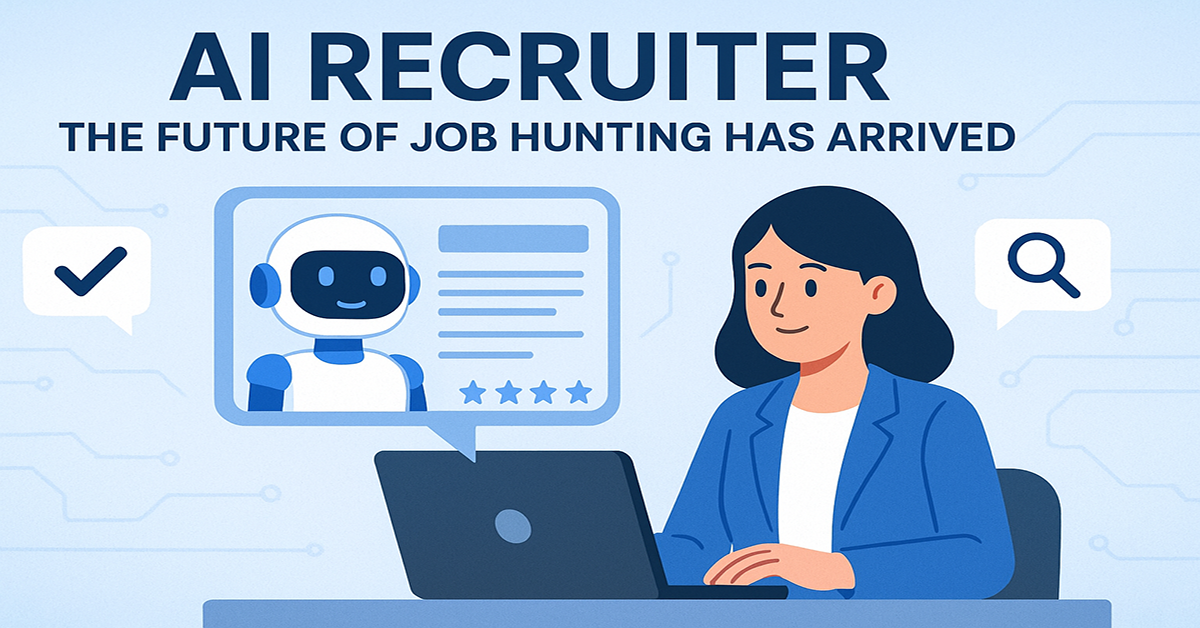
The hiring world is changing faster than ever, and one innovation is making headlines everywhere: the AI recruiter. Once considered futuristic, artificial intelligence is now stepping into the recruiterโ€™s role โ€” scanning rรฉsumรฉs, interviewing candidates, and even predicting which applicants are most likely to thrive in a given role.

This shift is transforming the way companies hire and how job seekers approach applications. And itโ€™s sparking one big question: Is the AI recruiter the future of job hunting?


What Is an AI Recruiter?

An AI recruiter is an intelligent hiring assistant powered by artificial intelligence. Instead of a human recruiter spending days filtering applications, AI tools can:

  • Analyze thousands of rรฉsumรฉs in minutes
  • Match candidatesโ€™ skills with job requirements
  • Conduct AI-driven video or chat interviews
  • Predict long-term job performance based on data

Companies see AI recruiters as a way to cut costs, save time, and improve hiring accuracy. But job seekers have mixed reactions to being evaluated by a machine.


Why AI Recruiters Are Going Viral

AI recruiting is trending across industries because it delivers undeniable advantages:

  1. Speed โ€“ Candidate shortlisting takes minutes, not weeks.
  2. 24/7 Availability โ€“ AI never sleeps and can respond instantly.
  3. Efficiency โ€“ Hiring managers can focus on top candidates faster.
  4. Data-Driven Decisions โ€“ Patterns and analytics reveal talent that might otherwise be overlooked.

These benefits explain why global companies are adopting AI recruiting tools at a rapid pace.


The Controversial Side of AI Recruiting

Despite the hype, AI recruiters also face criticism and concern:

  • Algorithm Bias โ€“ If the AI is trained on biased data, it may replicate discrimination.
  • Keyword Dependence โ€“ Candidates often game the system by overloading rรฉsumรฉs with buzzwords.
  • Lack of Human Touch โ€“ Soft skills, creativity, and personality can be overlooked.
  • Privacy Issues โ€“ Advanced systems analyze tone, facial expressions, and even online presence, raising ethical questions.

This blend of innovation and controversy is what makes the topic of AI recruiters so viral.


The Future of Job Applications

Industry experts predict that by 2030, most initial screenings will be conducted by AI recruiters. For job seekers, this means adapting strategies to work with technology rather than against it. To stand out, candidates should:

โœ… Use relevant keywords naturally within rรฉsumรฉs
โœ… Highlight measurable achievements and results
โœ… Practice for AI-powered video interviews
โœ… Keep digital footprints professional and consistent


Conclusion

The AI recruiter is more than just a trend โ€” itโ€™s a turning point in global hiring practices. Companies view it as a smarter, faster, and more cost-effective way to build teams, while candidates face the challenge of appealing to both humans and algorithms.

Whether seen as an innovation or a disruption, one thing is clear: the AI recruiter is here to stay, and it could redefine the future of job hunting.

Share on social media: